Uncover how ZEISS’s quality standards go far beyond ISO 9001, employing a robust, multi-layered “Zero Defects” methodology with specialized processes for unrivaled precision.
ISO 9001 is a globally recognized standard for quality management systems (QMS), providing a framework for organizations to ensure they consistently meet customer and regulatory requirements. However, in industries where microns count and performance is paramount, relying solely on ISO 9001 is often insufficient. For ZEISS, a world leader in optics and optoelectronics, ISO 9001 serves as the crucial baseline, but their commitment to precision and performance demands a much more comprehensive, and multi-faceted, approach to quality, answering two questions:
#1: Is ISO 9001 the only quality standard ZEISS uses?
The direct answer is No, absolutely not. While ISO 9001:2015 certification is fundamental across the entire ZEISS Group, it is just one component of a much broader and deeper quality ecosystem.
ZEISS understands that quality isn’t just about adhering to a generic set of rules; it’s about exceeding the specific and demanding requirements of the diverse markets they serve. A “one-size-fits-all” approach won’t work when you are manufacturing everything from semiconductor lithography optics (with accuracies down to the atomic level) to surgical microscopes and high-end cinematography lenses.
Therefore, ZEISS employs a nested and sector-specific strategy for quality certification and management.
#2: What does ZEISS do that goes beyond the ISO 9001 standard?
ZEISS pushes quality significantly further than the general requirements of ISO 9001 by implementing industry-specific standards, proprietary methodologies, and advanced engineering practices. This multi-layered approach ensures their products are not just “compliant” but are truly “best-in-class.”
Here is a look at the key elements that set ZEISS’s quality approach apart:
1. Sector-Specific Certifications
ZEISS doesn’t just hold the general QMS certification. Their different business units are certified to much more stringent standards tailored to their respective fields. This ensures that the unique challenges and regulatory demands of each sector are met with specialized quality processes. Examples include:
- Medical Technology (e.g., Surgical Microscopes, Ophthalmic Systems): Adherence to ISO 13485, the rigorous quality management standard for medical devices. This includes specific requirements for product safety, traceability, clinical evaluation, and risk management that go far beyond what ISO 9001 demands.
- Semiconductor Manufacturing Technology (e.g., Lithography Optics): This sector operates at the theoretical limits of physics. It adheres to internal standards that far exceed generic industrial requirements, and potentially aligns with specific Customer-specific Requirements (CSRs) from key partners. Quality here is managed at the nanometer and even picometer level, involving extreme cleanliness, environmental controls, and absolute stability.
- Metrology and Industrial Quality Solutions: This division must maintain certifications (like ISO/IEC 17025 for calibration laboratories) that demonstrate competence in making measurements. This ensures the tools they build to measure quality for other companies are themselves verified to the highest international standards.
2. The “Zero Defects” Philosophy (TPM, Kaizen, Six Sigma)
While ISO 9001 encourages a process approach and continuous improvement, ZEISS embeds this into their culture with a specific “Zero Defects” mandate. They don’t just aim for “low error rates”; they aim for perfection. This is supported by integrating several well-established methodologies that go beyond simple compliance:
- Total Productive Maintenance (TPM): Focusing on maximizing equipment effectiveness to prevent defects and downtimes.
- Kaizen (Continuous Improvement): Creating a culture where every employee is empowered to identify and implement incremental quality improvements.
- Six Sigma / Lean Six Sigma: Employing rigorous, data-driven methodologies to reduce process variation and eliminate waste (defects).
3. Proprietary Measurement and Testing Methodologies
ZEISS is not just a user of metrology; they are the inventors of many fundamental metrology concepts and tools. This means their internal standards for measurement are often stricter than any external certification. Examples include:
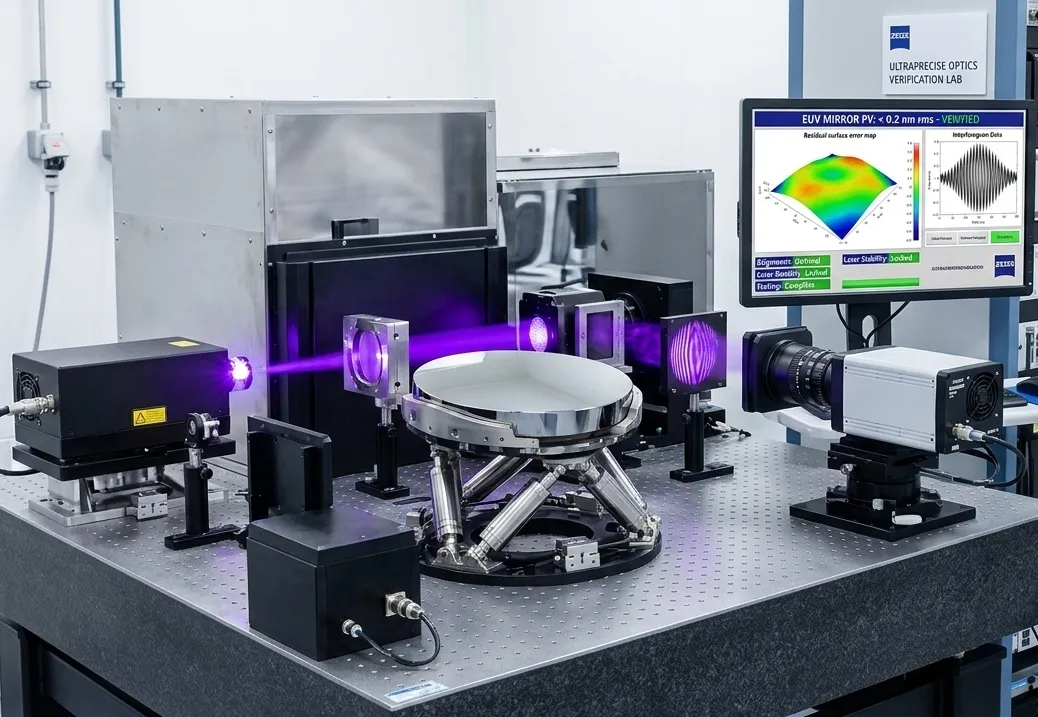
- Ultra-Precise Interferometry: Used to measure the surface accuracy of their optics (lenses and mirrors) to within a fraction of the wavelength of light. For EUV lithography optics, this accuracy is measured in picometers (trillionths of a meter).
- Coordinate Measuring Machines (CMMs): Utilizing their own world-class CMMs to measure the dimensional accuracy of mechanical components to extremely tight tolerances. This ensures perfect integration between the optics and the mechanical systems that hold them.
- Advanced Optical Design (Simulations and Modeling): Their quality process starts long before physical manufacturing. They utilize sophisticated proprietary software to simulate and optimize optical performance, predicting potential issues and designing for manufacturability (DFM) and reliability (DFR).
4. Advanced Materials and Environmental Controls
The highest quality often begins with the materials themselves. ZEISS has specialized knowledge in:
- Optical Glass Formulation: Developing and manufacturing their own specialized glass types to achieve specific optical properties.
- Material Traceability: Maintaining detailed records of material batches to track any issues back to their source.
- Cleanroom Manufacturing: Utilizing state-of-the-art cleanrooms (Class 1 or better) with precise temperature, humidity, and vibration controls for critical assembly and testing processes. This is essential for preventing contamination that could degrade optical performance.
5. Robust Supplier Quality Management
ZEISS recognizes that their final product quality is heavily dependent on their supply chain. Their supplier quality management processes go beyond the simple assessments mandated by ISO 9001. This includes:
- Strategic Partnership: Collaborating closely with key suppliers on product design and manufacturing processes.
- On-site Audits: Conducting detailed audits of suppliers’ quality management systems and manufacturing lines.
- Strict Incoming Inspection: Rigorously testing incoming materials and components to ensure they meet the precise specifications before they are accepted for production.